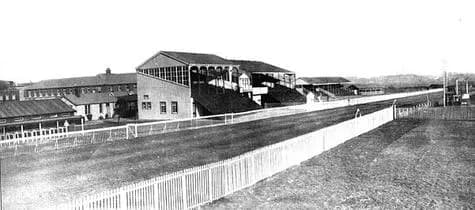
Walk across Trelai Park in Ely today and there is little to suggest that this quiet stretch of Cardiff once attracted some of the biggest crowds in Welsh racing.
For more than 80 years, Cardiff had a racecourse of its own here.
It was at Ely that the first Welsh Grand National was staged in 1895, beginning a race that eventually moved east and became one of the biggest days of the year at Chepstow.
This October, Cardiff racegoers can follow that history up the M4 as Chepstow stages three consecutive days of its Welsh Racing Festival from Friday 9th to Sunday 11th October.
There has, however, been a significant late change.
After the exceptionally dry summer, Chepstow's chase course has not recovered sufficiently for racing. The British Horseracing Authority has therefore moved the scheduled chases elsewhere and turned all three festival days into hurdle-only cards.
The three biggest races remain, but the Welsh Champion Hurdle has been brought forward to Friday 9th October.
Three days of Welsh racing
The DragonBet Welsh Racing Festival begins on Friday 9th October with two of the weekend's major races.
The Grade 2 Persian War Novices' Hurdle has a reputation for producing horses worth remembering. Previous winners include Silviniaco Conti, Blaklion and Thyme Hill.
This year it shares the opening day with the Welsh Champion Hurdle.
That race had originally been expected later in the weekend, but the revised programme now puts it alongside the Persian War on Friday.
Saturday 10th October is headed by the Silver Trophy Handicap Hurdle, traditionally one of the most competitive races of Chepstow's autumn meeting.
Rambo T, winner of the race last year, is being prepared to return and attempt to defend his title.
The festival then concludes on Sunday 11th October with a seven-race hurdles card.
It is an unusual festival programme, but there is a good reason for it. After months of unusually dry conditions, the decision was taken not to use Chepstow's chase course rather than risk racing horses over unsuitable ground.
The hurdle course remains available.
It means one of Welsh racing's biggest autumn weekends will look slightly different in 2026, a year in which Chepstow is also celebrating a century of racing at the course.
When Cardiff had a racecourse
For Cardiff, the story begins much closer to home.
Ely Racecourse opened in 1855, with its first meeting held on 30th May.
The course grew out of the Cardiff Race Club and the enthusiasm of sporting families and landowners around Glamorgan.
Within a few years, racing at Ely had become an established part of Cardiff life.
Then came the race that would define it.
The first Welsh Grand National was staged at Ely in 1895 and won by Deerstalker.
Huge crowds became associated with the meeting, sometimes reaching around 40,000. On one particularly chaotic occasion spectators overwhelmed the entrances as people attempted to get into the course without paying.
For several decades the Welsh National belonged to Cardiff.
It is strange to picture today.
Where families now walk dogs, play football and cross the open ground of Trelai Park, thousands once gathered around fences and grandstands to watch some of the country's leading racehorses.
The end of racing at Ely
By the early twentieth century, Ely's position had begun to weaken.
Crowds declined and competition from other courses grew.
Then, in 1937, fire swept through the grandstand.
The damage was considerable. Temporary structures allowed racing to continue, but the course never properly recovered.
On 27th April 1939, the final race was run.
A horse called Grasshopper won it, ridden by Keith Piggott.
The name gained another significance in racing history through his son, Lester Piggott, who would become one of Britain's greatest jockeys.
Ely never reopened.
The old racecourse was eventually transformed into what is now Trelai Park, although its history has not completely disappeared from the landscape.
The Welsh Grand National survived too.
After the war it was briefly revived at Newport before finding the home it still has today.
The race moves to Chepstow
Chepstow Racecourse had opened in 1926 on the old Piercefield estate overlooking the Wye Valley.
The Welsh Grand National arrived there in 1949.
Over the decades that followed, Chepstow increasingly became the centre of major Welsh racing.
That makes 2026 particularly significant.
Chepstow is celebrating its centenary this year, almost exactly a century after the first horses raced there and 131 years after the Welsh Grand National began in Cardiff.
The modern Welsh Racing Festival is another attempt to establish a major meeting around the beginning of the core jumps season.
And one of its headline races has itself travelled around Wales.
The return of the Welsh Champion Hurdle
The Welsh Champion Hurdle was first staged at Chepstow in 1969.
For a period it attracted some exceptional horses.
Bula, Night Nurse, Monksfield and Sea Pigeon all appear among its winners.
The race eventually disappeared from the calendar after 2002 before being revived at Ffos Las in 2011.
It returned to Chepstow last year as part of the new Welsh Racing Festival.
This year it takes place on Friday 9th October and carries £50,000 in prize money.
Trainer Sam Thomas and jockey Dylan Johnston have won the race for the past two years, first with Lump Sum at Ffos Las in 2024 and then Celtic Dino after its return to Chepstow in 2025.
They are aiming for a third consecutive victory, this time with Doctor Blue.
A Welsh festival worth the journey from Cardiff
Chepstow is an interesting racecourse even without the history.
It is a large, left-handed track with considerable changes in elevation and a long finishing straight.
Normally the meeting would mix hurdles with steeplechases, but the revised 2026 programme means racegoers will see hurdles throughout the weekend.
That also makes this year's festival something of an anomaly.
The weather responsible for the change has caused problems across British jump racing this autumn, with fixtures cancelled and races transferred as courses struggle after the prolonged dry spell.
Chepstow's major hurdle races, however, remain unaffected.
For someone going racing for the first time, there is no need to spend the afternoon buried in a form book.
Get there early enough to see the horses in the parade ring, watch the jockeys head onto the course and find somewhere near the finishing straight for the races themselves.
Betting is optional. If you do have a bet, decide beforehand what you are comfortable spending and treat it as part of the day's entertainment.
Children aged 17 and under can attend the festival free with an accompanying adult, subject to the racecourse's admission conditions.
From Cardiff to Chepstow
Chepstow is straightforward to reach from Cardiff.
Trains run from Cardiff Central towards Chepstow, while the racecourse provides raceday transport information for connections from the station.
By road, the journey follows the M4 east before crossing towards Chepstow on the M48.
It is also worth leaving time for the town itself.
Chepstow Castle towers over the River Wye and has stood there in some form since shortly after the Norman conquest.
Tintern Abbey lies further up the Wye Valley, while the riverside around Chepstow makes an easy addition to a day at the races.
There is another journey worth making afterwards, though, and it requires travelling only as far as Ely.
Walk through Trelai Park and imagine the same ground more than a century ago.
Grandstands, bookmakers, horses and spectators filled a part of Cardiff that now gives almost no indication of what once happened there.
The Welsh Grand National may have moved on, but part of the history of Welsh racing is still beneath your feet.
The DragonBet Welsh Racing Festival takes place at Chepstow Racecourse from Friday 9th to Sunday 11th October. This year's meeting will consist entirely of hurdle races following changes caused by the prolonged dry conditions.
Check Chepstow Racecourse before travelling for the latest race times, tickets, transport arrangements and ground conditions.